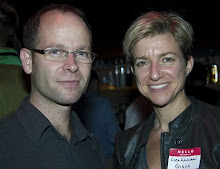
I had the pleasure of moderating a panel at OMMA Global NYC last Friday on performance marketing in social media. Thanks to the MediaPost folks and Cathy Taylor in particular for putting on such a great show. My panelists were a sharp threesome: Amy Gibby of eSpin/Hearst, Jamie Tedford of Brand Networks, and Mike Miller of OfferPal. The panel presented case studies on how they has successfully planned, measured and implemented campaigns with measurable ROI or cost-per-action for their clients. It's exciting for me to see performance marketers make strides in social media, as those measurable results will help bolster advertising in the space as brand advertising evolves.
What was surprising about the session is that about 40% of attendees had actually implemented some sort of social media marketing effort. However when I asked "Which if you know how your campaign or effort is doing?" there were no hands raised - that's zero, nada. No one in the audience had any idea if their efforts were worthwhile.
My thoughts? Bravo for testing the waters, but to run a successful test requires setting some sort of benchmarks and metrics for yourself. Even if it's early days and external benchmarks aren't available, set your own. Set them relative to other online efforts. Set them based on your own logic or intuition. Just set some. A successful test doesn't mean successful results, it just means you've learned something - learned how one effort compares to another, either simultaneous or subsequent. This is the foundation for learning.
Showing posts with label Advertising. Show all posts
Showing posts with label Advertising. Show all posts
Monday, September 22, 2008


Sunday, April 13, 2008
Eyeblaster and the Digital Evangelists charter event
Last Thursday night I joined an interesting gathering of people who are actively thinking and making things happen in the world of interactive media and advertising. The event was sponsored by John Haake and the folks at Eyeblaster, but was set up simply as an opportunity for the group to get to know each other and take steps to continue the conversation beyond the evening.
The group spent much of the evening discussing the challenges they face moving interactive advertising forward. What I found quite interesting, and truthfully a bit depressing, was the fact that many of the challenges are inherent to the agency-client structure and haven't changed in the 15 years I've been working in advertising. Issues of control, ownership and incentives are still the primary barriers to fast progress. On the other hand the fact that smart people are still pushing on what they think is right makes me hopeful for change.
Mirroring the industry's challenge of fragmenting media and user created and controlled media was the variation within our own group in terms of communication preferences: del.icio.us, email, twittering, Facebook, LinkedIn - everyone used a different set of tools and no one could agree on a preference.
Being a widget evangelist I have to refer to John Morton's great post on the evening:
"The word “widget” was mentioned approximately 112 times, but I lost count somewhere in the mid-60s. Why was “widget” talked about so much? It’s a buzz word of the moment that’s started to stick with people across the marketing industry. The term has stuck, but not a definition of what it means is pretty vague. . . .. Again, here’s another topic that I think we can explore further."
John I couldn't agree with you more and look forward to helping to make widgets a more clearly defined set of marketing opportunities. Check out this link to see some of the intial forays into branded widget advertising.
I'm looking forward to continuing the dialog and really enjoyed meeting everyone that evening.
As the lone West Coaster it was of course a treat to be out in NYC, at ValBella Restaurant; David Pogue of the NYT is really a lovely guy - my thanks go out to him for tracking down a cab to share at the end of the evening.
Attendees: Amy Auerbach from PHD, David Berkowitz from Marketer’s Studio, Matt Enos from Tribal DDB, Amaya Garbayo from Mindshare, John Haake from Eyeblaster, Liza Hausman from Gigya, Alex Jorissen from Eyeblaster, Lindsey Kollross from MEC, Gefen Lamdan from Eyeblaster, John Morton (me) from johnfmorton.com LLC, Linda Payson from Avenue A | Razorfish, David Pogue from The New York Times, Adam Romero from Agency.com, Adam Shlachter from MEC, Troels Smit from Eyeblaster, Doug Stivers from Beyond Interactive, Persia Tatar from Media Post, and Ben Weisman from Eyeblaster and Digitas and Lucas Binder of UBS.
The group spent much of the evening discussing the challenges they face moving interactive advertising forward. What I found quite interesting, and truthfully a bit depressing, was the fact that many of the challenges are inherent to the agency-client structure and haven't changed in the 15 years I've been working in advertising. Issues of control, ownership and incentives are still the primary barriers to fast progress. On the other hand the fact that smart people are still pushing on what they think is right makes me hopeful for change.
Mirroring the industry's challenge of fragmenting media and user created and controlled media was the variation within our own group in terms of communication preferences: del.icio.us, email, twittering, Facebook, LinkedIn - everyone used a different set of tools and no one could agree on a preference.
Being a widget evangelist I have to refer to John Morton's great post on the evening:
"The word “widget” was mentioned approximately 112 times, but I lost count somewhere in the mid-60s. Why was “widget” talked about so much? It’s a buzz word of the moment that’s started to stick with people across the marketing industry. The term has stuck, but not a definition of what it means is pretty vague. . . .. Again, here’s another topic that I think we can explore further."
John I couldn't agree with you more and look forward to helping to make widgets a more clearly defined set of marketing opportunities. Check out this link to see some of the intial forays into branded widget advertising.
I'm looking forward to continuing the dialog and really enjoyed meeting everyone that evening.
As the lone West Coaster it was of course a treat to be out in NYC, at ValBella Restaurant; David Pogue of the NYT is really a lovely guy - my thanks go out to him for tracking down a cab to share at the end of the evening.
Attendees: Amy Auerbach from PHD, David Berkowitz from Marketer’s Studio, Matt Enos from Tribal DDB, Amaya Garbayo from Mindshare, John Haake from Eyeblaster, Liza Hausman from Gigya, Alex Jorissen from Eyeblaster, Lindsey Kollross from MEC, Gefen Lamdan from Eyeblaster, John Morton (me) from johnfmorton.com LLC, Linda Payson from Avenue A | Razorfish, David Pogue from The New York Times, Adam Romero from Agency.com, Adam Shlachter from MEC, Troels Smit from Eyeblaster, Doug Stivers from Beyond Interactive, Persia Tatar from Media Post, and Ben Weisman from Eyeblaster and Digitas and Lucas Binder of UBS.
Monday, March 3, 2008
Widget challenges are opportunties
Kudos to Jeremiah Owyang for continuing to ask the difficult questions around the widget/social media economy in his recent post and again today on his panel at the Graphing Social Patterns West conference.
Before getting down to business I just have to ask: Why all the posts with pictures of the hotel and pool? Yes, it's sunny and beautiful here but you can find the same pictures on the hotel website, plus we're all indoors, not at the pool. But I digress.
First, I do agree with many of these challenges as described at a high level - 1) it's a new space and the metrics are not yet established and consistent, it's definitely something I'm working towards on almost a daily basis in order to deliver real long-term value to our brand advertiser clients 2) immature market - by definition given the age of the industry and 3) difficult to monetize - certainly many are finding this challenging.
What I don't agree with:
1) "advertising is not an effective way to monetize in social networks" - while many are failing because the user attention is not there for traditional display or ad sense ads, advertising done as part of the experience and/or entertainment content itself makes sense - and we're seeing not only the adoption but the detailed interaction with these branded widgets. Nobody wants to see a full blown commercial in the middle of watching a movie, but remember what E.T. did for Reese's Pieces. It just has to be executed well.
2) CPI as bastardization. This comment was a bit of a head-scratcher for me. I tend to give users a lot of credit for being rational actors - they use or take what they like, and get rid of what they don't. You can't say on the one hand that there are low barriers to entry, the space is cluttered with clones and there are very few high value widgets, and then say that one of the few effective ways of breaking through that clutter is inappropriate. If users don't like the widget they can say "no thanks" or if they got it wrong then they'll delete it. Over the long term a bad user experience can't be overcome with a CPI strategy. If Jeremiah is simply saying that VC money is funding the promotion of bad apps, I won't argue with that; I'll just say that it can't go on forever and isn't the foundation of a real business.
CPI makes the most sense to me for two reasons: The first is context - the biggest challenge for advertisers (whether brands or app/widget marketers) is reaching people at the right time - reaching widget users at the time they are updating their pages with new content is exactly the right time to present them with additional choices. The second is a bit more difficult to explain, but brand advertisers who are used to CPM buys still want to get those impressions, but they want them on user profile pages, and they want to pay for and receive them over a matter of weeks or months, in conjunction with a broader ad campaign. To get those profile impressions and meet that criteria, they need to secure installs via CPI. Otherwise it's anyone's guess what they'll get. The media has to be accountable, i.e. what you budget for is delivered, in the time period designated.
3) Low Utility. Jeremiah says: "I’m trying to think of a widget that provides business utility, or one that improves my life other than casual communications or entertainment. Reminiscent of the web in the mid 90s, we’ve yet to see the business value."
I don't disagree there is enormous opportunity in the area of business value, but what drives virality and the enormous popularity of MySpace and Facebook is, as Ari Paparo
so nicely put it, the "make my day" factor. Not the business utility. While I personally, like Jeremiah, love a great new networking or business tool - this misses the point of what the majority of social network users are looking for in the majority of apps and widgets - fun and escape in conjunction with friends.
4) Disposable. I suppose this depends on your point of view - certainly it's more efficient for developers to build an app or widget with staying power - but along the lines of points 1 and 3 above, when it comes to brand advertiser widgets a relatively short life might be entirely appropriate for the campaign objectives, and still represent a really fun and entertaining and valued experience for the person using it. Objectives really are the key here - an advertiser might build a tool for long-term dialog, but something entirely different to drive awareness of a new product - matching the vehicle to the goals is crucial.
Jeremiah, thanks for chatting with me today and asking my honest opinion. I certainly appreciate your insights and perspective. Maybe next year they'll hold the conference in August, by the pool.
Before getting down to business I just have to ask: Why all the posts with pictures of the hotel and pool? Yes, it's sunny and beautiful here but you can find the same pictures on the hotel website, plus we're all indoors, not at the pool. But I digress.
First, I do agree with many of these challenges as described at a high level - 1) it's a new space and the metrics are not yet established and consistent, it's definitely something I'm working towards on almost a daily basis in order to deliver real long-term value to our brand advertiser clients 2) immature market - by definition given the age of the industry and 3) difficult to monetize - certainly many are finding this challenging.
What I don't agree with:
1) "advertising is not an effective way to monetize in social networks" - while many are failing because the user attention is not there for traditional display or ad sense ads, advertising done as part of the experience and/or entertainment content itself makes sense - and we're seeing not only the adoption but the detailed interaction with these branded widgets. Nobody wants to see a full blown commercial in the middle of watching a movie, but remember what E.T. did for Reese's Pieces. It just has to be executed well.
2) CPI as bastardization. This comment was a bit of a head-scratcher for me. I tend to give users a lot of credit for being rational actors - they use or take what they like, and get rid of what they don't. You can't say on the one hand that there are low barriers to entry, the space is cluttered with clones and there are very few high value widgets, and then say that one of the few effective ways of breaking through that clutter is inappropriate. If users don't like the widget they can say "no thanks" or if they got it wrong then they'll delete it. Over the long term a bad user experience can't be overcome with a CPI strategy. If Jeremiah is simply saying that VC money is funding the promotion of bad apps, I won't argue with that; I'll just say that it can't go on forever and isn't the foundation of a real business.
CPI makes the most sense to me for two reasons: The first is context - the biggest challenge for advertisers (whether brands or app/widget marketers) is reaching people at the right time - reaching widget users at the time they are updating their pages with new content is exactly the right time to present them with additional choices. The second is a bit more difficult to explain, but brand advertisers who are used to CPM buys still want to get those impressions, but they want them on user profile pages, and they want to pay for and receive them over a matter of weeks or months, in conjunction with a broader ad campaign. To get those profile impressions and meet that criteria, they need to secure installs via CPI. Otherwise it's anyone's guess what they'll get. The media has to be accountable, i.e. what you budget for is delivered, in the time period designated.
3) Low Utility. Jeremiah says: "I’m trying to think of a widget that provides business utility, or one that improves my life other than casual communications or entertainment. Reminiscent of the web in the mid 90s, we’ve yet to see the business value."
I don't disagree there is enormous opportunity in the area of business value, but what drives virality and the enormous popularity of MySpace and Facebook is, as Ari Paparo
so nicely put it, the "make my day" factor. Not the business utility. While I personally, like Jeremiah, love a great new networking or business tool - this misses the point of what the majority of social network users are looking for in the majority of apps and widgets - fun and escape in conjunction with friends.
4) Disposable. I suppose this depends on your point of view - certainly it's more efficient for developers to build an app or widget with staying power - but along the lines of points 1 and 3 above, when it comes to brand advertiser widgets a relatively short life might be entirely appropriate for the campaign objectives, and still represent a really fun and entertaining and valued experience for the person using it. Objectives really are the key here - an advertiser might build a tool for long-term dialog, but something entirely different to drive awareness of a new product - matching the vehicle to the goals is crucial.
Jeremiah, thanks for chatting with me today and asking my honest opinion. I certainly appreciate your insights and perspective. Maybe next year they'll hold the conference in August, by the pool.
Smells like fear of new media
I just finished reading "Struggles of a Mad Man" in the Dec 3, 2007 issue of Business Week. The article looks at Saatchi & Saatchi CEO Kevin Roberts and how both his traditional advertising business "may be flirting with irrelevance".
As a former media buyer for FCB in the early 90's, it's certainly been fascinating (and fun) to see the balance of power shift more towards the folks with data and quantifiable results. It's what I find so exciting about the continued convergence of media and creative - like social media applications / widgets - the line between creative and inventory these days is certainly blurring. So I was taken aback to see there are still senior advertising people like Roberts who think that creative and analytical are two completely different worlds. Roberts is quoted as saying "A media agency couldn't emotionally touch the consumer in a million years," "They have no f---ing idea. They don't have feelings. They're media people." Wow. Granted, most media agencies weren't founded to do great creative, but to assert that media people don't "get" brand building and connecting with people smells more like fear than insight.
As a former media buyer for FCB in the early 90's, it's certainly been fascinating (and fun) to see the balance of power shift more towards the folks with data and quantifiable results. It's what I find so exciting about the continued convergence of media and creative - like social media applications / widgets - the line between creative and inventory these days is certainly blurring. So I was taken aback to see there are still senior advertising people like Roberts who think that creative and analytical are two completely different worlds. Roberts is quoted as saying "A media agency couldn't emotionally touch the consumer in a million years," "They have no f---ing idea. They don't have feelings. They're media people." Wow. Granted, most media agencies weren't founded to do great creative, but to assert that media people don't "get" brand building and connecting with people smells more like fear than insight.
Subscribe to:
Posts (Atom)